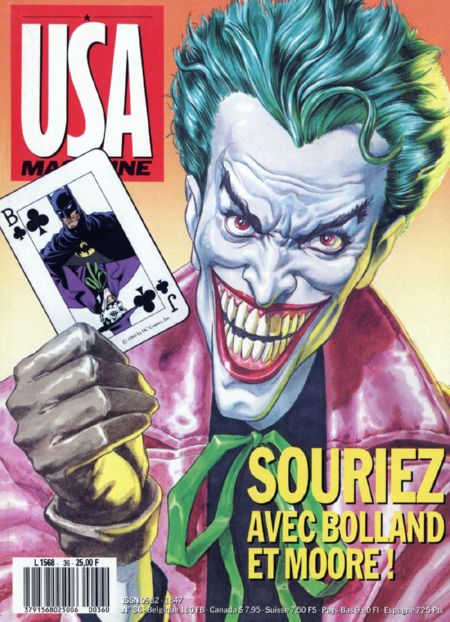
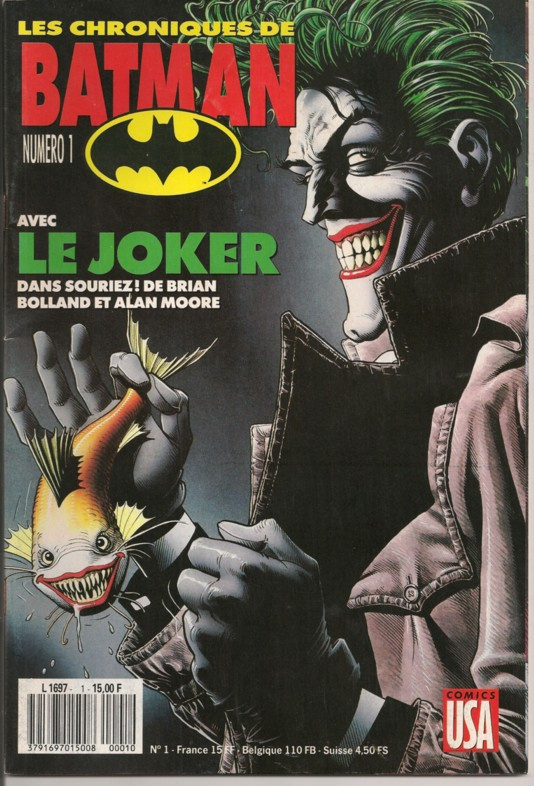
Décidément, il y a toujours beaucoup de rancoeur dans l’air quand on évoque les travaux d’Alan Moore chez DC Comics, et notamment le plus mal-aimé d’entre eux par son scénariste lui-même, à savoir « The Killing Joke ». Moore n’ayant pas la langue dans sa poche concernant ses collègues toujours dans l’industrie qu’il a fuie quant à lui, il n’est pas illogique que ce franc-parler « se retourne contre lui » à l’occasion. Revenant avec amertume sur « The Killing Joke », Brian Bolland n’épargne pas le mage de Northampton :
"Killing Joke. My final word (for now).
Much has been said about the Killing Joke, Alan Moore, Brian Bolland and John Higgins’ slim graphic novel about Batman and the Joker. It’s an item of great significance to me for a number of positive and negative reasons. I want to make this my definitive and comprehensive take on the Killing Joke. Much of this you may already have read and I apologise for repeating myself. Revelations about my personal pride in the work and the personal wounds it has inflicted in me may be something new to you.
In about 1985 I’d returned from a lengthy trip abroad and I rang up Dick Giordano to ask him what I could do next for DC Comics. The trip abroad had been paid for, in part, by a bonus from DC of $10,000 thanks to the success of Camelot 3000. In answer to my question Dick said “You can do anything you want, Brian”.
Skipping back a few years to 1977 - Dave Gibbons, Mick McMahon, Kevin O’Neil and I and a number of other artists had been in at the beginning of the UK’s newly launched 2000AD. We were a closely knit bunch of young artists. We met annually at the recently established Forbidden Planet shop in London to sign for 2000AD fans and monthly in local pubs for drinks and pizzas. We were mainly artists but soon joining that group was hairy Midlander (you could tell from his accent) Alan Moore. Pat Mills and John Wagner’s stories for Judge Dredd were outstanding and made that character rightly popular. Alan Moore’s writing, however, was in a league of its own. Literate, ingenious, irreverent, moving and funny. His “Time Twisters” with Dave Gibbons. “DR & Quinch” with Alan Davis. “The Bojeffries Saga” with Steve Parkhouse. His darker political magnum opus “V For Vendetta” with David Lloyd. All signals that here was a writer of some standing. The guys at Forbidden Planet had formed a publishing group called Titan Books. There were plans afoot to team up Alan and me to draw an alternative take on the American Superhero trope called “Rocket Redglare”. There were even discussions between IPC, publishers of 2000AD, and DC Comics about a “Batman vs Judge Dredd” one-off. I’d already started drawing a few things for DC at the time so contact had been made with the other side of the Pond. Neither projects came to anything. It’s understood that IPC, who published 2000AD weekly, were unimpressed by the poor sales of DC’s Batman at the time.
Dave Gibbons had been a close friend and mentor to me since I started in 1975 on Powerman. Alan became my friend a few years later as a result of the various events and conventions we jointly attended. At a con in the French alpine town of Grenoble (I have an amusing story to tell of that day which I’ll save for another time), also attended by Sergio Aragones, David Mazucchelli and Will Eisner, I sat for a long long time with Alan as he told me the plot of a story he was writing about Jack the Ripper. In London we chortled with delight as he played us his 45rpm record “the Sinister Ducks”. I remember him saying to me “You can’t have too many friends, Brian.”
In the mid 80s, during various pub get-togethers, Dave Gibbons revealed pages and plot points that he and Alan were working on for a new maxi-series for DC called Watchmen. Dave’s enthusiasm was infectious. We could tell it was going to be brilliant.
Back to 1985. Dick Giordano said to me “you can do anything you want to, Brian”. Frank Miller had recently redefined the look and format of a comic with his “Ronin” and redefined Batman with “Dark Knight”. Alan had finished writing Watchmen. I said to Dick “I’d like to do a Batman graphic novel and I’d like Alan Moore to write it”. Dick said “Okay”. Alan was asked and seemed happy to come onboard. He rang me and asked me what I had in mind. I said I’d like it to be primarily about the Joker with Batman as more of a background character. Len Wein would be the editor and we were all set to go.
During that period, my wife Rachel and I, were in New York and we met Frank Miller and Lynn Varley for a Japanese meal. I’d known Frank since my earliest visits to DC in 1979. When he visited me in London I took him on nocturnal walks around the bowels of East London, Ripper territory. Now - in New York he suggested a new Batman book from me might not be a good idea because, thanks to his Dark Knight, the character was a bit over-saturated. But, too late. It was already in production.
In London Alan rang me and said he’d reached a dark patch in the writing of Killing Joke. He thought he had to have the Joker do something REALLY bad to take him beyond his clownish comedic persona. He wanted to seriously injure Barbara Gordon, Batgirl. He’d asked Len Wein. It’s in print somewhere so I can repeat here what were Len’s words as repeated to me by Alan. “Cripple the bitch!”
Finally in London the finished script arrived. I was somewhat disappointed. As an artist you want to draw iconic moments. Pay homage in some way to the character of old. Where was Dick Sprang’s giant typewriter? I was worried by the three bug-eyed dwarves. I thought It perhaps offensive to persons of limited height. I thought setting part of the story in a funfair was a bit obvious. And - I was upset by the harm that came to Barbara and concerned by the implied nudity. As the artist I’ve never considered it my place to tell a writer what to write, especially a writer (and friend) who I admired as much as Alan. As an artist, if a scene has to be violent, I will make it so. Also I would never have chosen to suggest an origin story of the Joker. There were moments in the story, though, that I thought might be iconic and sections that were well up to Alan’s best.
Len Wein was no longer the editor of Killing Joke. That role was passed on to Denny O’Neil who, I believe, was the head Batman editor. I didn’t know Denny and I only recall one brief phone call with him. As far as I knew DC had forgotten about the Killing Joke. I worked away at it between 1986-88 along with covers for Titan’s Dredd reprints and other things. During that time I was hearing rumours that all was not well between Alan Moore and DC. Something to do with their agreement over Watchmen. I’m sketchy on the details and it’s best to investigate the matter elsewhere. I thought it possible that matters came to a head while Alan was writing Killing Joke - specifically round about the time he was harming Barbara Gordon. Maybe that was the reason for his phone call. Maybe he was on the verge of ditching Killing Joke and DC at that point. But that’s just speculation.
By 1988 My artwork was nearing completion and suddenly the book was scheduled. Back then colour was applied using the “blue line” process. I was too slow at that so John Higgins was asked to provide the colour. (There are more stories here which I’ll leave for another occasion. Including, in a book whose page composition consisted only of horizontals and verticals, Richard Brunning’s decision to tilt the logo diagonally).
For me the Killing Joke represented the perfect alignment of the planets. I had the opportunity to bring together characters, that I grew up with, that I loved, that were high profile and possibly the best and hottest writer of the moment. I knew this would be a career peak for me. Fortunately Killing Joke proved popular and has remained in print since its first appearance. Alan’s work has been celebrated in literary circles. Watchmen, I believe, is studied in schools. Alan’s rift with DC has widened into a rift with the whole superhero genre and comics as a whole - and, as far as I can tell with anyone he previously knew in that field. I rang him years ago, before I knew of the rift, and said I’d like to do something new with him, something good “…that would make a lot of money!” (I do this for a living after all.) since then I’ve had no contact with my old friend. Occasionally I see him on TV or hear him on the radio.
Killing Joke was meant to be the high watermark of my career. I knew I wasn’t capable of doing anything better. I was recently reading an article in the Guardian newspaper entitled “The Killing Joke at 30. What is the legacy of Alan Moore’s shocking Batman story?” (Not a recent article then?). “A 46 page psychological slug-fest.” It goes on to say “As Moore doesn’t speak about The Killing Joke (or any of his DC work) any more, and Wein died last year, it’s perhaps a piece of comics apocrypha we can analyse however we want”. It, however, quotes Alan thus: “I thought it was far too violent and sexualised a treatment for a simplistic comic book character like Batman and a regrettable misstep on my part”. KJ is sited by other sources as a high profile example of the routine ill-treatment of women in comics for entertainment and its a good thing if that can be rectified in the future.
At no point in the Guardian article is the name of the artist mentioned. People who use the medium of the written word to express themselves have no ability or interest in talking about line-thickness, negative space, light and shade or the influence of artists of the past. It’s “Alan Moore’s shocking Batman book”. A low point in his career. Not a particularly good story. A miss-step for him. A thing he’d prefer not to talk about. If an artist has done his job properly he or she will have conveyed the story well enough that he or she will not even be noticed. In that I have to feel some satisfaction.
Apart from my various pleasures and pride and my disappointments and regrets in The Killing Joke I regret the loss of a friend - and an extremely entertaining and talented one."